| Author and Year | Purpose of the Studies | Theoretical Aim | Population Studied | Number of Participants | Tool | Duration of Use Before Data Collection | Tasks Performed with Tablet | Quantitative or Qualitative Method | Data Collection Method | Country |
|---|---|---|---|---|---|---|---|---|---|---|
| Cacciamani et al. (2018) | Assessing the relationships between model components (effect of PU, PEU, affects, support conditions, empowerment in learning on learning and communicative use) according to frequency of use, gender, and grade | To assess UTAUT and TAM models | Secondary students | 296 | Unreported | 1 year | Various | Quantitative | Survey—closed questions | Italy |
| Ciampa (2014) | Identification of students’ experiences and perceptions associated with tablet use | Descriptive | Primary students | 24 | Unreported | 5 months | Various | Qualitative | Interviews | Canada |
| Clarke and Abbott (2016) | Identification of students’ experiences and perceptions associated with tablet use | Descriptive | Primary students | 27 | iPad | 5 months | Various | Qualitative | Interviews | Ireland |
| Courtois et al. (2014) | Assessing the evolution of the relationships between model components (attitude, subjective norm, perceived behavioral control, behavioral intention, and actual use) | To assess TPB model | Secondary students | 351 | iPad | 6 months | Various | Quantitative | Survey—closed questions | Belgium |
| Çukurbaşi et al. (2016) | Assessing factors that explain variance of model components (PEU, PU, attitude, behavioral intention) according to gender, tablet ownership, technology education, and schools | To assess TAM model | Secondary students | 2023 | Unreported | Unreported | Various | Quantitative | Survey—closed questions | Turkey |
| Dündar and Akçayir (2012) | Identification of students’ experiences and perceptions associated with tablet use | Descriptive | Primary students | 10 | iPad | One (first) use | One controlled reading task | Qualitative | Interviews | Turkey |
| Dündar and Akçayir (2014) | Comparison of attitudes toward the use of tablet computers (PEU, PU, affects toward computer) according to gender and experience | To assess TAM model | Secondary students | 206 | Android tablet | 6 months | Various | Mixed | Survey—closed and open questions | Turkey |
| Duran and Aytaç (2016) | Identify students’ experiences and perceptions associated with tablet use | Descriptive | Secondary students | 1439 | Unreported | Unreported | Various | Qualitative | Survey—closed and open questions | Turkey |
| Fekonja-Peklaj and MarjanovičUmek (2015) | Identify students’ experiences and perceptions associated with tablet use | Descriptive | Primary students | 12 | Unreported | 6 months | Various | Qualitative | Interviews | Slovenia |
| Ferguson (2017) | Comparison of students’ experiences and perceptions associated with tablets use according to gender and grade | Explicative-descriptive | Primary and secondary students | 676 | iPad | 8 or 20 months of use | Various | Mixed | Survey—closed and open questions | USA |
| Fokides and Mastrokoukou (2018) | Assessing students’ perceptions toward the use of tablets for collaborative learning task | Descriptive | Primary students | 75 | Unreported | Four 2-h sessions | Collaborative information seeking and exercises on specific app in biology courses | Qualitative | Survey—closed and open questions | Greece |
| Gokcearslan (2017) | Assessing the relationship between the level of acceptance of tablets (PU, PEU, attitude, and behavioral intention) and the level of self-directed learning with technology; comparison according to gender | To assess TAM1 model | Secondary students | 414 | Android tablet | Unreported | Various | Mixed | Survey—closed and open questions | Turkey |
| Görhan et al. (2014) | Comparison of students’ experiences and perceptions associated with tablet use according to gender, grade, and experience | Explicative-descriptive | Primary and secondary students | 414 | Unreported | Unreported | Various | Quantitative | Survey—closed questions | Turkey |
| Horzum et al. (2014) | Assessing the relationships between model components (PU, PEU, attitude, intention) and anxiety and readiness for educational usage of tablet | To assess TAM1 model | Secondary students | 1130 | Unreported | Unreported | Various | Quantitative | Survey—closed questions | Turkey |
| Huang et al. (2017) | Assessing perceived usefulness, ease of use, and satisfaction and behavioral intentions after using the tablet for academic tasks | Descriptive | Secondary students | 58 | Tablet (unreported) + virtual pen for tablet | 6 weeks of use | Individual exercises on specific app in English courses | Mixed | Survey—closed questions, Interviews | China |
| Hwang et al. (2015) | Assessing students’ perceptions (PEU, PU, and behavioral intention) | Descriptive | Primary students | 20 | Asus Transformer Pads | 3 weeks (20 min by week) | Individual exercises on specific app in mathematics courses | Qualitative | Survey—closed questions + interview | Taiwan |
| Hyppa-Martin et al. (2016) | Comparison of students’ experiences and perceptions associated with tablets according to gender | Explicative-descriptive | Primary students | 115 | iPad | One (first) use | Test of an augmentative and alternative communication system | Quantitative | Survey—closed questions | USA |
| Ifenthaler and Schweinbenz (2016) | Assessing the relationships between model components (effort expectancy, performance expectancy, social influence, attitude toward tablet, self-efficacy, facilitating conditions, behavioral intention, actual use) | To assess UTAUT, TAM, and TRA models | Secondary students | 120 | iPad | 10 months | Various | Quantitative | Survey—closed questions | Germany |
| Kaman and Ertem (2018) | Identify students’ experiences and perceptions associated with tablet use | Descriptive | Primary students | 15 | Unreported | 14 weeks of use (1 use by week) | Reading task | Qualitative | Semistructured interview | Turkey |
| Keane et al. (2013) | Identification of students’ experiences and perceptions associated with tablet use | Descriptive | Secondary students | 51 | iPad | Several years | Various | Qualitative | Survey—closed and open questions, Interviews | Australia |
| Kim and Jang (2015) | Assessing the relationships between PU, PEU, satisfaction, deepened experiences through tablet use, beliefs about the future, and self-efficacy | To create a structural research model | Primary students | 277 | Samsung Galaxy Note 10.1 (Android) | Unreported | Various | Quantitative | Survey—closed questions | Korea |
| Kontkanen et al. (2017) | Identify students’ experiences and perceptions associated with tablet use | Descriptive | Secondary students | 84 | iPad | 2 years | Various | Qualitative | Open questions (formulation of advice based on the TPACK framework) | Finland |
| Lin (2014) | Comparison of perceived usefulness, ease of use, and satisfaction after the use of tablet or laptop | To assess TAM2 model | Secondary students | 82 | iPad | 10 weeks of use | Individual documents consultation and exercises on specific app in English courses | Mixed | Survey—closed and open questions | Taiwan |
| Lin et al. (2012) | Comparison of perceptions according to modalities of collaborative use of tablet (1:1 or 1:m) | Explicative-descriptive | Primary students | 64 | Unreported | One use | Collaborative concept mapping on social studies lesson | Mixed | Survey—closed questions, Interviews | Taiwan |
| Ling (2016) | Comparison of students’ experiences and perceptions associated with tablet use according to gender, ethnicity, and experience | Explicative-descriptive | Secondary students | 404 | iPad | 6 months | Various | Qualitative | Survey—closed questions | USA |
| Montrieux et al. (2014) | Assessing the evolution of the relationships between model components (attitude, subjective norm, perceived behavioral control, PU, PEU, perceived enjoyment, status, behavioral intention, and actual use) | To assess TPB model | Secondary students | 351 | iPad | 6 months | Various | Quantitative | Survey—closed questions | Belgium |
| Montrieux et al. (2017) | Comparison of students’ experiences and perceptions associated with tablet use according to the nature of use (electronic book, guided and not-guided inquiry-based learning) and gender, age, and academic track | Explicative-descriptive | Secondary students | 139 | iPad | 6 months | Various | Quantitative | Survey—closed questions | Belgium |
| Niko and Mortensen (2014) | Comparison of students’ experiences and perceptions associated with tablet use | Explicative-descriptive | Secondary students | 91 | Unreported | 1 year | Digital book or inquiry learning | Qualitative | Survey—closed and open questions | Denmark |
| Papadakis and Kalogiannakis (2017) | Assessing relationships between the model components (PEU, PU, attitudes, and behavioral intention) | To assess TAM model | Secondary students | 78 | Android tablet | Unreported | Various | Quantitative | Survey—closed questions | Cyprus |
| Petko et al. (2017) | Assessing students’ attitudes toward tablets for academic tasks according to gender | Descriptive | Secondary students | 205 | iPad | 6 months | Various | Qualitative | Survey—closed questions | Turkey |
| Shin and Park (2015) | Assessing relationships between the model components (PEU, PU, attitudes, behavioral intention, and actual use) according to gender, grade, experience | To assess TAM model | Secondary students | 380 | iPad | 6 months | Various | Qualitative | Survey—closed questions | Europe |
| Srikoon et al. (2018) | Assessing students’ perceptions and the effect of the use of tablets on motivation and collaboration (focus on gender and experience) | Descriptive | Primary students | 201 | iPad | 7 weeks | Various tasks in English course | Quantitative | Survey—closed questions | Thailand |
| Su and Cherng (2015) | Comparison of students’ experiences and perceptions associated with tablet use | Explicative-descriptive | Secondary students | 62 | iPad | 1 year | Various | Mixed | Survey—closed questions, Interviews | Taiwan |
| Tzuriel and Shamir (2010) | Assessing the perceived use of tablets on students’ self-regulation and cognitive functions (comparison according to cognitive style) | Descriptive | Primary students | 178 | Unreported | 1 year | Various | Mixed | Survey—closed questions + interview | Israel |
| Vincent (2015) | Assessing relationships between PU, PEU, affects toward technology, and behavioral intention to use | To assess TAM1 model | Primary students | 202 | iPad | 18 weeks | Various | Qualitative | Survey—closed and open questions | USA |
| Wang et al. (2014) | Assessing students’ perceptions (PU, PEU, attitude, intention) | To assess TAM model | Secondary students | 88 | Cyprus | 1 year | Various | Qualitative | Survey—closed questions | Cyprus |
| Xiang et al. (2017) | Assessing students’ perceptions (PU, PEU, attitude, behavioral intention) | To assess TAM1 model | Secondary students | 76 | ASUS tablet | Unreported | Various | Quantitative | Survey—closed questions, Interviews | USA |
| Zhu et al. (2014) | Assessing students’ perceptions toward the use of tablets for collaborative learning task (focus on gender) | Descriptive | Primary students | 57 | iPad | 1 to 2 years | Various (using digital pen) | Qualitative | Survey—closed questions | Netherlands |
Resumen
A pesar de los impactos positivos observados en los 41 estudios sistematizados por Mulet et al. (2019) sobre el uso de tabletas en entornos educativos, la efectividad puede variar significativamente según factores como el género, el grado, la experiencia y la naturaleza de las tareas realizadas con las tablets. Esta diversidad en los resultados señala la necesidad de un enfoque más específico y personalizado en la integración de las tabletas en el ámbito educativo, así como la importancia de abordar las posibles limitaciones y desafíos asociados, como las distracciones y las dificultades técnicas, para optimizar su uso y maximizar su impacto en el aprendizaje estudiantil.
Principales ideas
Implicaciones educativas para una mejor integración de las tabletas en la educación
Las conclusiones del análisis de los diferentes estudios aportan información útil para integrar más eficientemente las tabletas en los contextos educativos y satisfacer las necesidades de los estudiantes.
En primer lugar, los estudios demostraron que las tablets se adaptan mejor a tareas de visualización (lectura, búsqueda de información, visualización de documentos multimedia o de Internet), tareas de grabación (grabación de audio y vídeo) y ejercicios o tareas de comunicación. Por el contrario, las tabletas son menos adecuadas para tareas importantes de escritura con el teclado digital; En este caso, las tabletas suelen tener una percepción negativa. Entonces, el papel de los docentes y de la orientación parece muy importante para transmitir una visión positiva al alumnado.
Si bien algunos docentes podrían suponer que las tablets promueven la autonomía de los estudiantes, los hallazgos tienden más a mostrar que los estudiantes deben ser acompañados y guiados por docentes. Del mismo modo, el uso intensivo de tablets en el aula puede provocar que los estudiantes experimenten fatiga visual debido a la pantalla retroiluminada.
Se deben continuar las investigaciones sobre los diseños pedagógicos de tareas y recursos con tabletas. Facilitar el aprendizaje y mejorar la experiencia de los estudiantes debería contribuir a una educación más relevante basada en herramientas digitales.
Metodología
La cuestión de la percepción de las tablets para el aprendizaje no es insignificante para comprender la adopción y posterior uso de esta herramienta en el aula. Como los enfoques metodológicos son importantes para comprender los hallazgos relacionados con la percepción estudiantil, esta revisión se centró primero en las metodologías aplicadas y luego en los resultados de estos estudios. Por lo tanto, en esta revisión se abordan dos preguntas de investigación principales:
[1] ¿Cómo se estudian las percepciones de los estudiantes sobre el uso de tabletas para el aprendizaje?
[2] ¿Cuáles son las percepciones de estos estudiantes y sus determinantes?
Replicabilidad potencial, si es un experimento
Más detalles
Tabla de percepciones sobre esfuerzo
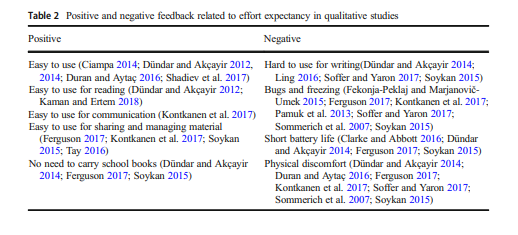
Tabla sobre actitudes
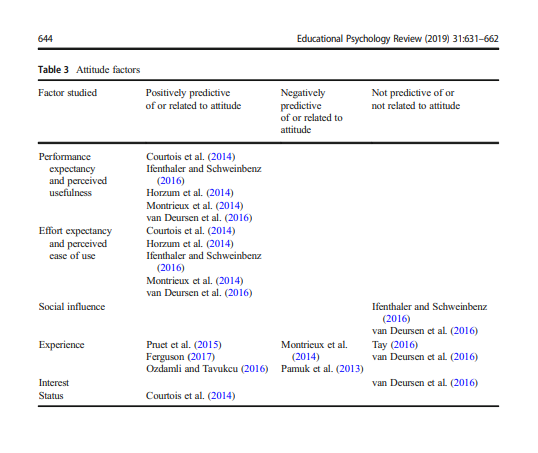
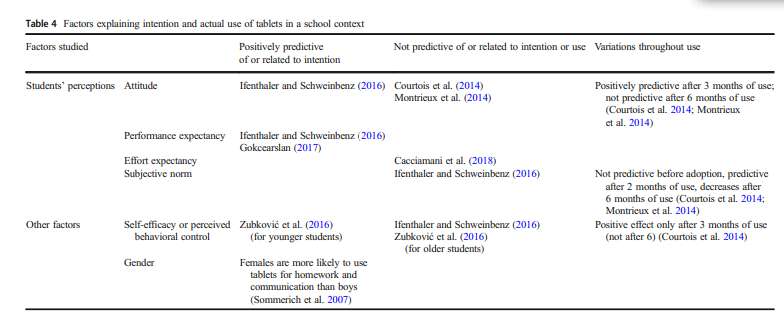
Tabla sobre factores explicativos
Abstract
Existe un interés creciente por el uso de tabletas en las aulas y las políticas educativas de diferentes países promueven su integración. Se realizaron revisiones bibliográficas anteriores sobre los efectos del uso de tabletas en el aprendizaje. Sin embargo, existe una gran necesidad de comprender cómo los estudiantes perciben el uso de tabletas para el aprendizaje, ya que estas percepciones determinan la adopción, el uso y, por tanto, el valor de las tabletas para el aprendizaje. Así, el propósito de este artículo es revisar sistemáticamente la literatura existente sobre las percepciones de los estudiantes hacia el uso de tabletas en escuelas primarias y secundarias. La búsqueda bibliográfica seleccionó 41 estudios cualitativos y cuantitativos relevantes que cumplían con nuestros criterios de inclusión. Se analizaron y discutieron sus resultados y aspectos metodológicos. En general, los resultados mostraron que los estudiantes tienen percepciones bastante buenas sobre el uso de tabletas, aunque se destacaron algunas limitaciones, particularmente en los estudios cualitativos. Además, esta revisión destacó la complementariedad de los métodos cuantitativos y cualitativos. Finalmente se discutieron las implicaciones educativas y las recomendaciones para futuras investigaciones.
El análisis de los estudios seleccionados revela una amplia gama de hallazgos sobre el uso de tabletas en entornos educativos. Los estudios tuvieron como objetivo predominante evaluar varios modelos como UTAUT (Teoría Unificada de Aceptación y Uso de la Tecnología), TAM (Modelo de Aceptación de Tecnología) y TPB (Teoría del Comportamiento Planificado) para comprender la aceptación y el uso de tabletas por parte de los estudiantes. Los factores comunes explorados incluyeron la facilidad de uso percibida (PEU), la utilidad percibida (PU), las actitudes hacia la tecnología, las intenciones de comportamiento y el uso real. Muchos estudios destacaron los impactos positivos del uso de tabletas en el compromiso, la motivación y los resultados del aprendizaje de los estudiantes, particularmente en entornos de aprendizaje colaborativos e interactivos. Sin embargo, la efectividad varió según factores como el género, el grado, la experiencia y la naturaleza de las tareas realizadas con las tabletas. Los estudios cualitativos a menudo se centraron en las experiencias y percepciones de los estudiantes, revelando tanto los beneficios como los desafíos asociados con el uso de tabletas, incluidos problemas relacionados con distracciones y dificultades técnicas.
Análisis automático
Parsing text into sentences and tokens...DONE
Calculating pairwise sentence similarities...DONE
Applying LexRank...DONE
Formatting Output...DONE
[1] "(2016) variance of model TAM students questions components (PEU, PU, model attitude, behavioral intention) according to gender, tablet ownership, technology education, and schools Educational Psychology Review (2019) 31:631–662 Table 5 (continued) Author and Purpose of the studies Theoretical Population Number of Tool Duration of use before Tasks Quantitative/ Data Country year aim studied participants data collection performed qualitative collection with tablet method method Dündar and Identification of students’ Descriptive Primary 10 iPad One (first) One controlled Qualitative Interviews Turkey Akçayir (2012) experiences and students use reading task perceptions associated with tablet use Dündar and Comparison of attitudes To assess Secondary 206 Android 6 months Various Mixed Survey—closed Turkey Akçayir (2014) toward the use of tablet TAM students tablet and open computers (PEU, PU, model questions affects toward computer) according to gender and experience Duran and Aytaç Identify students’ experiences Descriptive Secondary 1439 Unreported Unreported Various Qualitative Survey—closed Turkey (2016) and perceptions students and open Educational Psychology Review (2019) 31:631–662 associated with tablet use questions Fekonja-Peklaj Identify students’ experiences Descriptive Primary 12 Unreported 6 months Various Qualitative Interviews Slovenia and and perceptions associated students Marjanovič- with tablet use Umek (2015) Ferguson (2017) Comparison of students’ Explicative- Primary and 676 iPad 8 or 20 months Various Mixed Survey—closed USA experiences and descriptive secondary of use and open perceptions associated students questions with tablets use according to gender and grade Fokides and Assessing students’ Descriptive Primary 75 Unreported Four 2-hsessions Collaborative Qualitative Survey—closed Greece Mastrokoukou perceptions toward the students information and open (2018) use of tablets for seeking and questions collaborative learning task exercises on specific app in biology courses Gokcearslan Assessing the relationship To assess Secondary 414 Android Unreported Various Mixed Survey—closed Turkey (2017) between the level of TAM1 students tablet and open acceptance of tablets (PU, model questions PEU, attitude, and behavioral intention) and the level of self-directed learning with technology; 653 Table 5 (continued) 654 Author and Purpose of the studies Theoretical Population Number of Tool Duration of use before Tasks Quantitative/ Data Country year aim studied participants data collection performed qualitative collection with tablet method method comparison according to gender Görhan et al."
[2] "(2016) experiences and descriptive students use augmentative questions perceptions associated and alternative with tablets according to communication gender system Ifenthaler and Assessing the relationships To assess Secondary 120 iPad 10 months Various Quantitative Survey—closed Germany Schweinbenz between model UTAUT, students questions (2016) components (effort TAM, and expectancy, performance TRA expectancy, social models Educational Psychology Review (2019) 31:631–662 Table 5 (continued) Author and Purpose of the studies Theoretical Population Number of Tool Duration of use before Tasks Quantitative/ Data Country year aim studied participants data collection performed qualitative collection with tablet method method influence, attitude toward tablet, self-efficacy, facilitating conditions, behavioral intention, actual use) Kaman and Ertem Identify students’ experiences Descriptive Primary 15 Unreported 14 weeks of use Reading Qualitative Semistructured Turkey (2018) and perceptions students (1 use by week) task interview associated with tablet use Keane et al."
[3] "(2017) experiences and descriptive students inquiry learning and open perceptions associated questions with tablet use according to the nature of use (electronic book, guided and not-guided inquiry- based learning) and gender, age, and academic track Norqvist (2016) Assessing whether tablets are Descriptive Secondary 23 Unreported Unreported Various Qualitative Interview (based Denmark integrated into learning in students on the theory students’ opinion of group cognition) Ozdamli and Comparison of students’ Explicative- Secondary 319 iPad 6 months Various Quantitative Survey—closed Cyprus Tavukcu attitude before and after descriptive students questions (2016) tablet use and according to gender Descriptive 918 Unreported 6 months Various Qualitative Turkey Educational Psychology Review (2019) 31:631–662 Table 5 (continued) Author and Purpose of the studies Theoretical Population Number of Tool Duration of use before Tasks Quantitative/ Data Country year aim studied participants data collection performed qualitative collection with tablet method method Pamuk et al." 
Nota
Dündar y Akçayir (2012): Este estudio tuvo como objetivo identificar las experiencias y percepciones de los estudiantes relacionadas con el uso de tabletas. En él participaron 10 estudiantes de primaria que utilizaron iPads para una tarea de lectura controlada. Los datos se recopilaron a través de entrevistas cualitativas en Turquía.
Dündar y Akçayir (2014): Esta investigación comparó las actitudes de los estudiantes de secundaria hacia el uso de tabletas versus computadoras. El estudio evaluó a 206 estudiantes utilizando el modelo TAM durante seis meses. Se empleó un enfoque de método mixto, utilizando encuestas con preguntas cerradas y abiertas en Turquía.
Duran y Aytaç (2016): Este estudio identificó las experiencias y percepciones de los estudiantes de secundaria sobre el uso de tabletas. Involucraron a 1.439 estudiantes, pero no se informaron la tableta específica ni la duración. La recopilación de datos fue cualitativa, mediante encuestas con preguntas cerradas y abiertas en Turquía.
Fekonja-Peklaj y Marjanovič-Umek (2015): Esta investigación examinó las experiencias y percepciones de 12 estudiantes de escuela primaria en Eslovenia que utilizaron tabletas durante seis meses. Los datos fueron recolectados a través de entrevistas cualitativas.
Ferguson (2017): Este estudio comparó las experiencias y percepciones de estudiantes de primaria y secundaria sobre el uso de tabletas según el género y el grado. En él participaron 676 estudiantes que utilizaron iPads durante 8 a 20 meses, y los datos se recopilaron mediante encuestas de métodos mixtos en los EE. UU.
Fokides y Mastrokoukou (2018): Esta investigación evaluó las percepciones de 75 estudiantes de escuela primaria en Grecia sobre el uso de tabletas para el aprendizaje colaborativo. El estudio implicó cuatro sesiones de dos horas de duración con una aplicación específica en cursos de biología, mediante encuestas cualitativas con preguntas cerradas y abiertas.
Gokcearslan (2017): Este estudio evaluó la relación entre la aceptación de tabletas y el aprendizaje autodirigido con tecnología entre 414 estudiantes de secundaria en Turquía. Se utilizó el modelo TAM y los datos se recolectaron mediante encuestas de método mixto con preguntas cerradas y abiertas.
Ifenthaler y Schweinbenz (2016): Este estudio evaluó las relaciones entre los componentes de los modelos UTAUT, TAM y TRA entre 120 estudiantes de secundaria en Alemania que usaron iPads durante 10 meses. Los datos se recopilaron cuantitativamente a través de encuestas cerradas.
Kaman y Ertem (2018): Esta investigación identificó las experiencias y percepciones de 15 estudiantes de escuela primaria en Turquía asociadas con 14 semanas de uso de tabletas. Los datos fueron recolectados a través de entrevistas cualitativas semiestructuradas.
Keane y cols. (2017): Este estudio examinó las experiencias y percepciones de los estudiantes que utilizan tabletas para diversas tareas, como libros electrónicos y aprendizaje basado en la investigación. Se centró en género, edad y trayectoria académica, recopilando datos a través de encuestas descriptivas con preguntas cerradas y abiertas.
Norqvist (2016): Este estudio evaluó si las tabletas se integraban al aprendizaje en función de las opiniones de los estudiantes. En él participaron 23 estudiantes de secundaria de Dinamarca, y los datos se recopilaron cualitativamente a través de entrevistas basadas en la teoría de la cognición grupal.
Ozdamli y Tavukcu (2016): Esta investigación comparó las actitudes de los estudiantes antes y después de usar tabletas, en la que participaron 319 estudiantes de secundaria en Chipre durante seis meses. Los datos se recopilaron cuantitativamente a través de encuestas cerradas.
Pamuk et al. (2016): En este estudio descriptivo participaron 918 estudiantes en Turquía durante seis meses, y se recopilaron datos cualitativos para evaluar diversas tareas realizadas con tabletas.
Referencia
Reutilización
Cómo citar
BibTeX
@online{robano2024,
  author = {Robano, Virginia},
  title = {Resumen de la revisión sistemática de la literatura sobre
    percepciones de uso de tablets para el aprendizaje hecha por Mulet
    et al., 2019},
  date = {2024-05-30},
  url = {https://ceibal-fichas-edtech.netlify.app/posts/review of perceptions of tablets for learning/},
  langid = {es}
}
Por favor, cita este trabajo como:
Robano, Virginia. 2024. “Resumen de la revisión sistemática de la
literatura sobre percepciones de uso de tablets para el aprendizaje
hecha por Mulet et al., 2019.” May 30, 2024. https://ceibal-fichas-edtech.netlify.app/posts/review
of perceptions of tablets for learning/.